

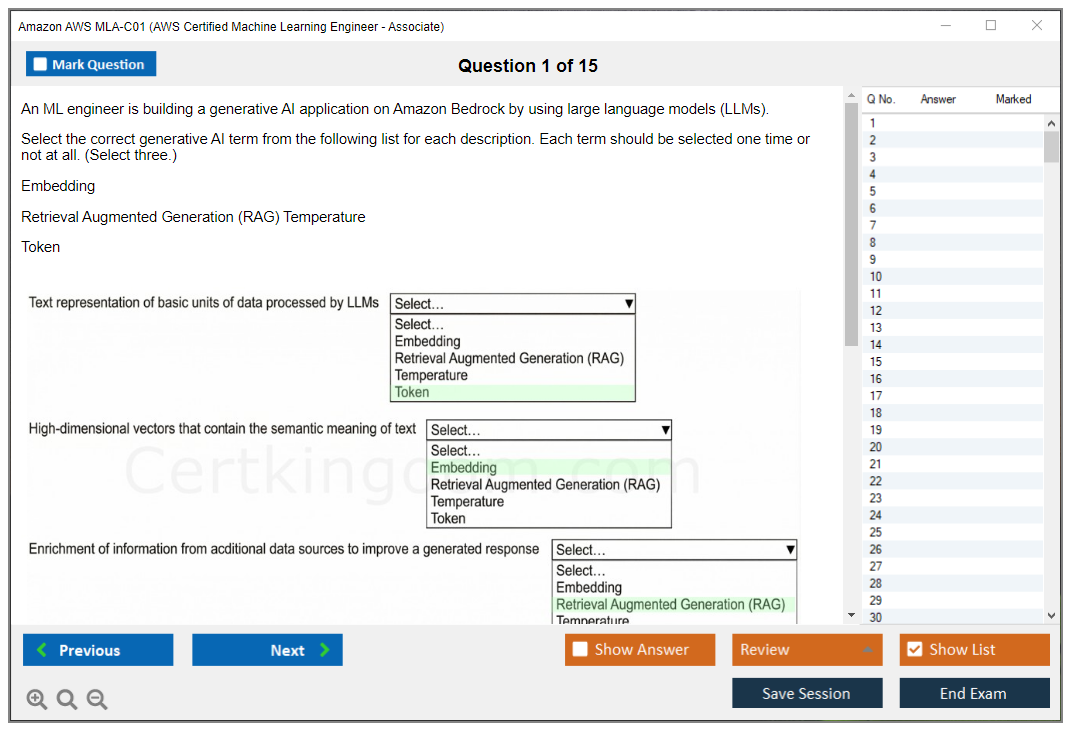
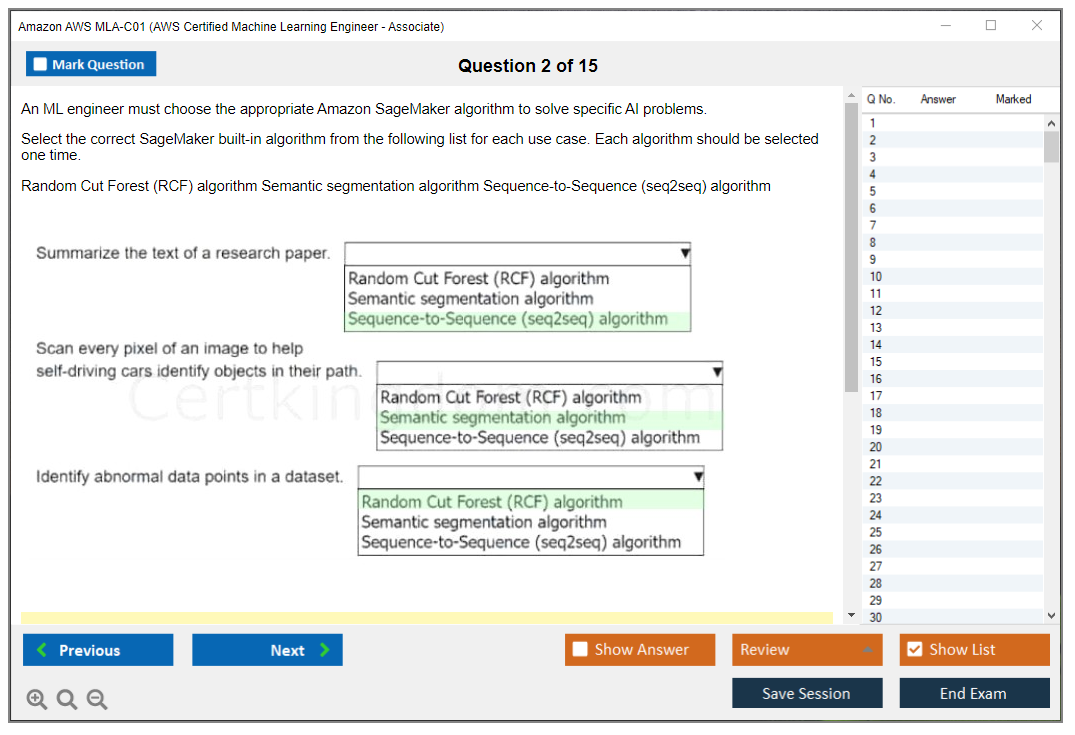
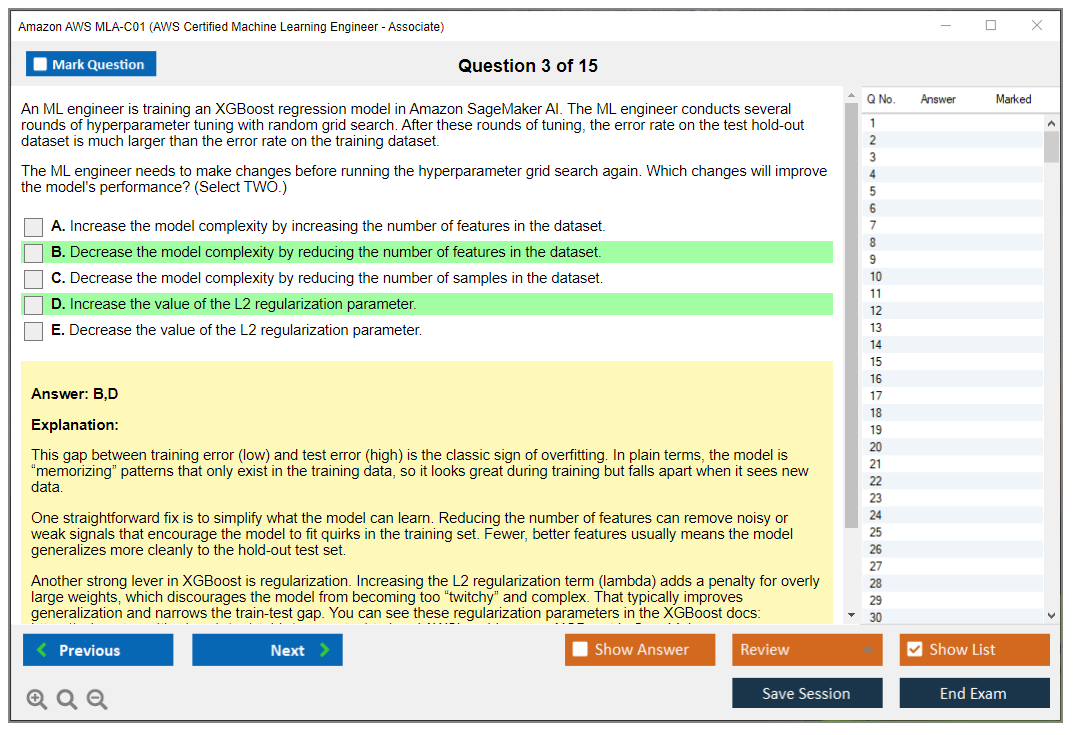
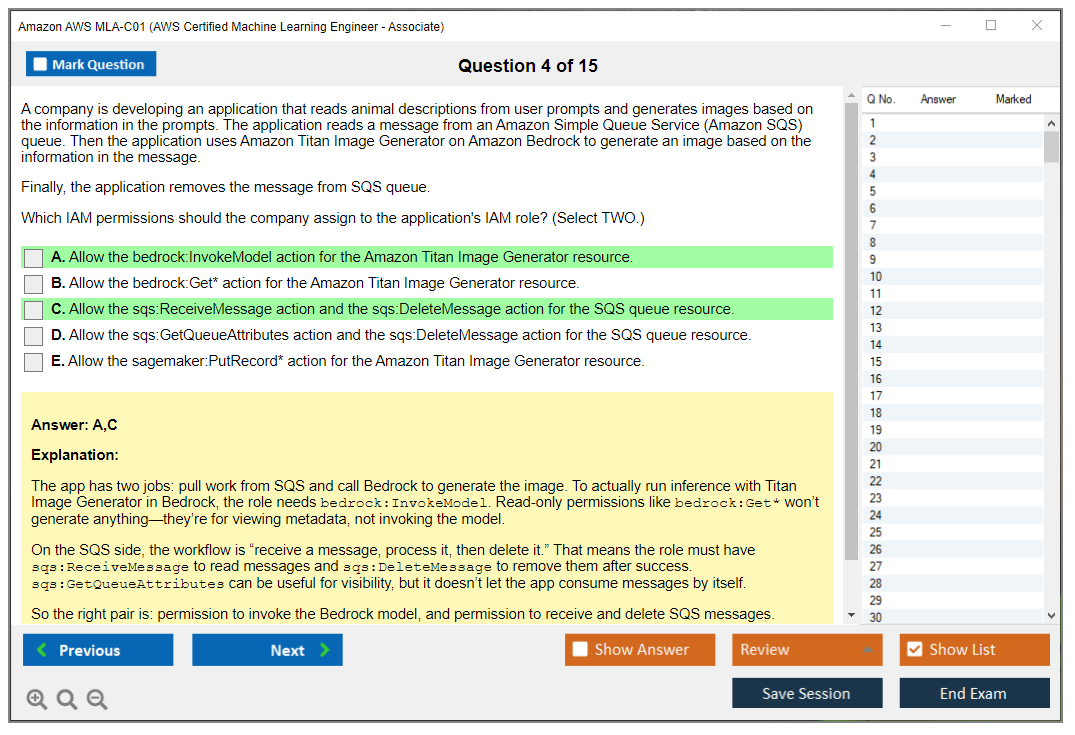
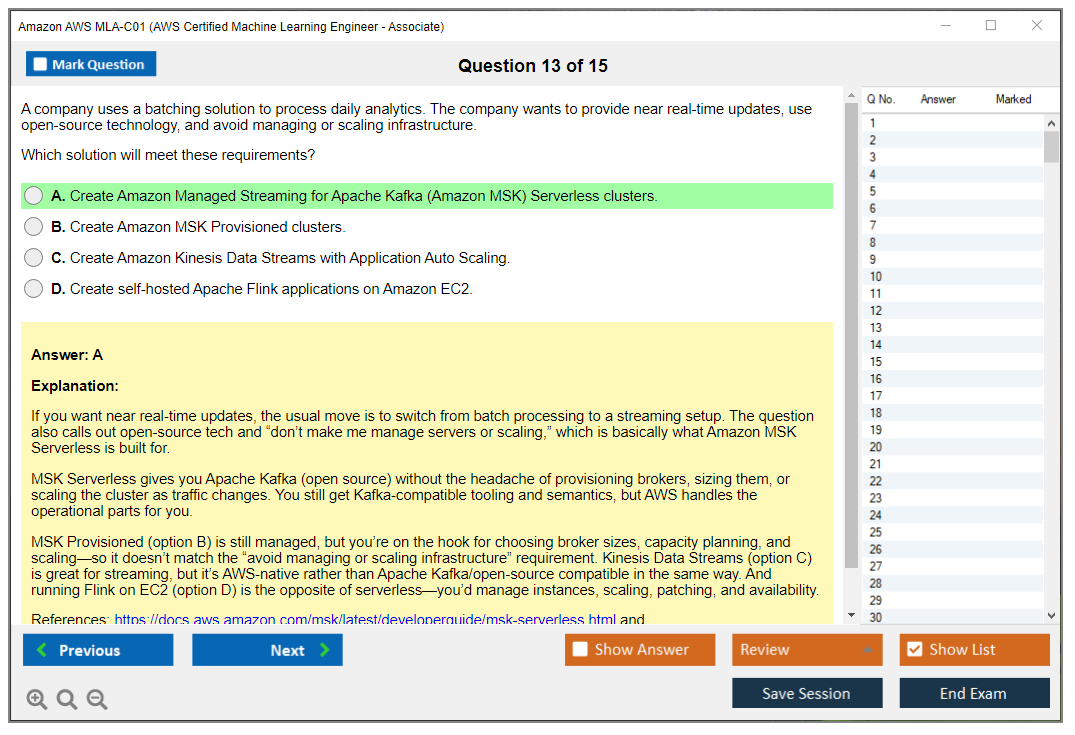
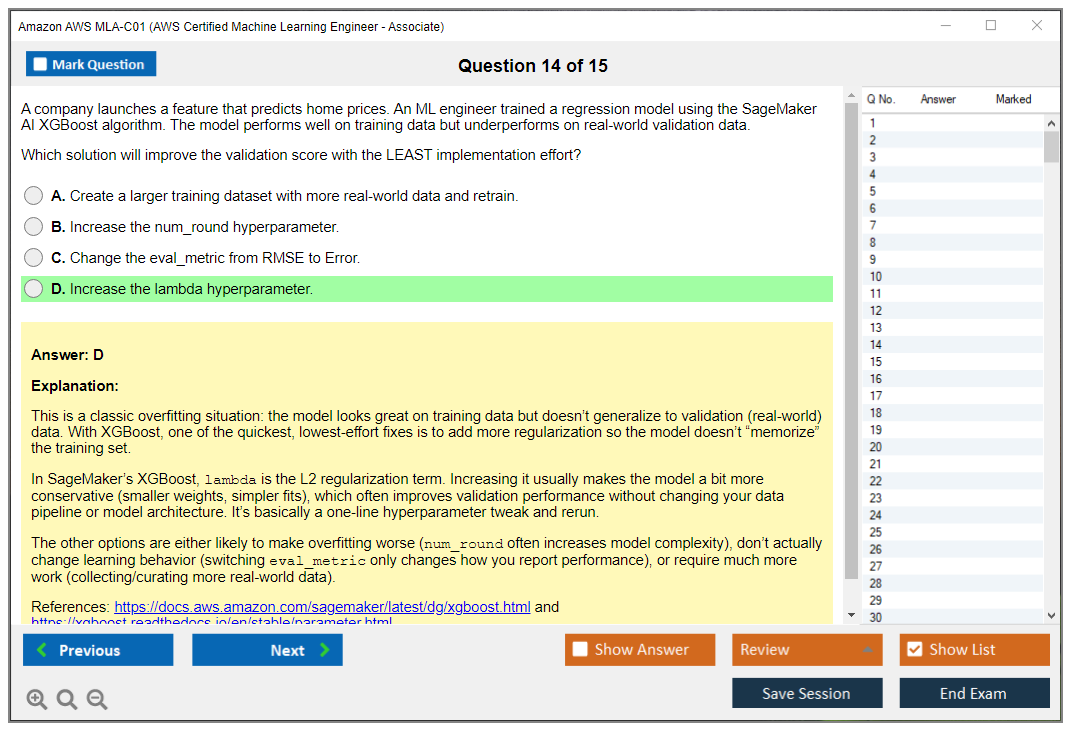
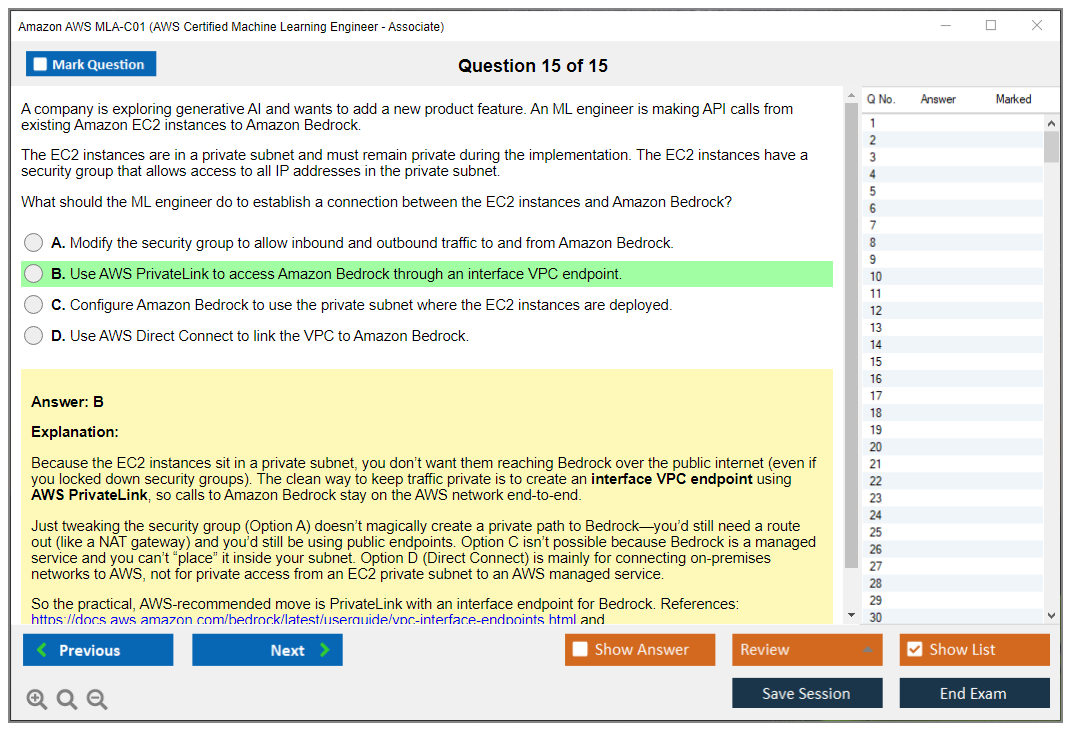
Amazon AWS MLA-C01 Certification Overview
The AWS MLA-C01 certification dropped in 2024 and honestly it feels like Amazon finally gets what the industry needs. I've seen too many data scientists build amazing models that never make it to production because nobody knows how to actually deploy and maintain them. This cert addresses that gap head-on.
This is Amazon's first associate-level credential specifically targeting ML engineers rather than data scientists or general cloud folks. The AWS Certified Machine Learning Engineer Associate validates you can actually build, train, and deploy ML models on AWS without everything catching fire in production. It sits in this interesting middle ground where you need more than basic cloud knowledge but you're not expected to be a PhD-level researcher either.
Why AWS created this certification
The ML specialty cert's been around for a while but it's more theoretical and research-heavy. Companies kept telling AWS they needed people who could handle MLOps on AWS day-to-day. Someone who knows when to use SageMaker Pipelines versus Lambda. Someone who can debug why model drift's killing your predictions. Someone who understands that CI/CD for ML's completely different from regular software deployment.
The timing makes sense. Every company now has a data science team building models in notebooks but getting those models into production applications is where everything falls apart. You need engineers who speak both languages. This cert proves you can bridge that gap.
What you're actually proving
Real-world scenarios, that's it.
The exam tests whether you can handle end-to-end ML workflows on AWS infrastructure. Data ingestion from S3 or RDS. Feature engineering at scale. Training jobs that don't blow your budget. Deployment patterns that actually work under load. Monitoring that catches problems before your CEO asks why recommendations are terrible.
Amazon SageMaker certification skills form the core here and you need to know SageMaker Studio inside out. How Pipelines orchestrate workflows, what the Model Registry actually does, deployment options from real-time endpoints to batch transform jobs. But it's SageMaker. You'll work with IAM policies for ML workloads, VPC configurations for secure training, cost optimization strategies because ML training gets expensive fast.
The exam emphasizes practical scenarios over theory. They'll describe a business problem and ask which architecture makes sense. Should you use multi-model endpoints or separate endpoints? When does batch inference make more sense than real-time? How do you handle A/B testing between model versions? These questions require hands-on experience, not just reading documentation. Which reminds me of this project where we spent three weeks optimizing real-time inference only to realize batch would've worked fine and cost 80% less, but that's the kind of lesson you only learn by screwing it up first.
Who this certification targets
ML engineers obviously. Also DevOps folks transitioning into MLOps roles, software developers who need to implement ML features in their applications, data engineers building pipelines that feed ML systems. If you're touching production ML systems on AWS, this cert validates your skills.
Companies increasingly need people who can work across the full stack. The days of throwing models over the wall to operations teams? Over. You need to understand model development enough to work with data scientists but also know infrastructure well enough to deploy and scale reliably.
How it fits in AWS's certification space
This complements rather than replaces other AWS certs. Many people doing SAA-C03 already have the foundational AWS knowledge you need. DVA-C02 helps if you're implementing ML in applications. The AWS Certified Machine Learning - Specialty goes deeper into algorithms and theory while MLA-C01 focuses on engineering and operations.
Starting with CLF-C02 makes sense if you're new to AWS entirely, then MLA-C01, then maybe the ML Specialty if you want to go deeper. Some folks come from DOP-C02 backgrounds and find the MLOps concepts familiar but need to learn the ML-specific services.
Core technical areas covered
You need to know the complete ML lifecycle on AWS from data prep through monitoring. Data ingestion from various sources. Handling data quality issues. Feature stores for reusable features. Training distributed models. Hyperparameter tuning at scale. Managing experiment tracking. Deployment patterns including edge deployment for IoT scenarios. Multi-model endpoints for cost efficiency. Auto-scaling inference endpoints.
Security matters more than people think. IAM policies for least-privilege access to training data and models, encryption at rest and in transit, VPC configurations for isolated training environments, compliance considerations for regulated industries. I've seen production systems get hacked because someone didn't configure SageMaker notebook instance security properly.
Cost optimization's huge. Training jobs can burn thousands of dollars if you pick the wrong instance types. Spot instances for fault-tolerant training workloads, right-sizing inference endpoints, using batch transform instead of real-time when latency requirements allow. The exam tests whether you can make smart tradeoffs between performance and cost.
Integration with the broader AWS ecosystem
ML systems don't exist in isolation. You're pulling data from RDS, DynamoDB, or streaming from Kinesis. Storing training data and model artifacts in S3 with proper lifecycle policies. Using Lambda for preprocessing or postprocessing. Container orchestration with ECS or EKS for custom training environments. CloudWatch for monitoring, CloudTrail for auditing, EventBridge for workflow orchestration.
The exam tests how well you understand these integrations. When should you use Glue for ETL versus custom preprocessing in SageMaker Processing jobs? How do you trigger model retraining when new data arrives in S3? What's the right way to serve models through API Gateway with Lambda versus direct SageMaker endpoints?
Framework knowledge and tooling
You need familiarity with common ML frameworks even though you're not writing algorithms from scratch. TensorFlow, PyTorch, scikit-learn, XGBoost and how they integrate with SageMaker's built-in algorithms and bring-your-own-container options. Understanding when to use framework-specific features versus SageMaker abstractions.
Docker becomes important for custom training and inference code. You're not just deploying models, you're containerizing entire ML workflows. Git for version control of training code and configuration, parameter stores for managing hyperparameters and secrets. The tooling ecosystem matters as much as the ML services themselves.
Production ML operational concerns
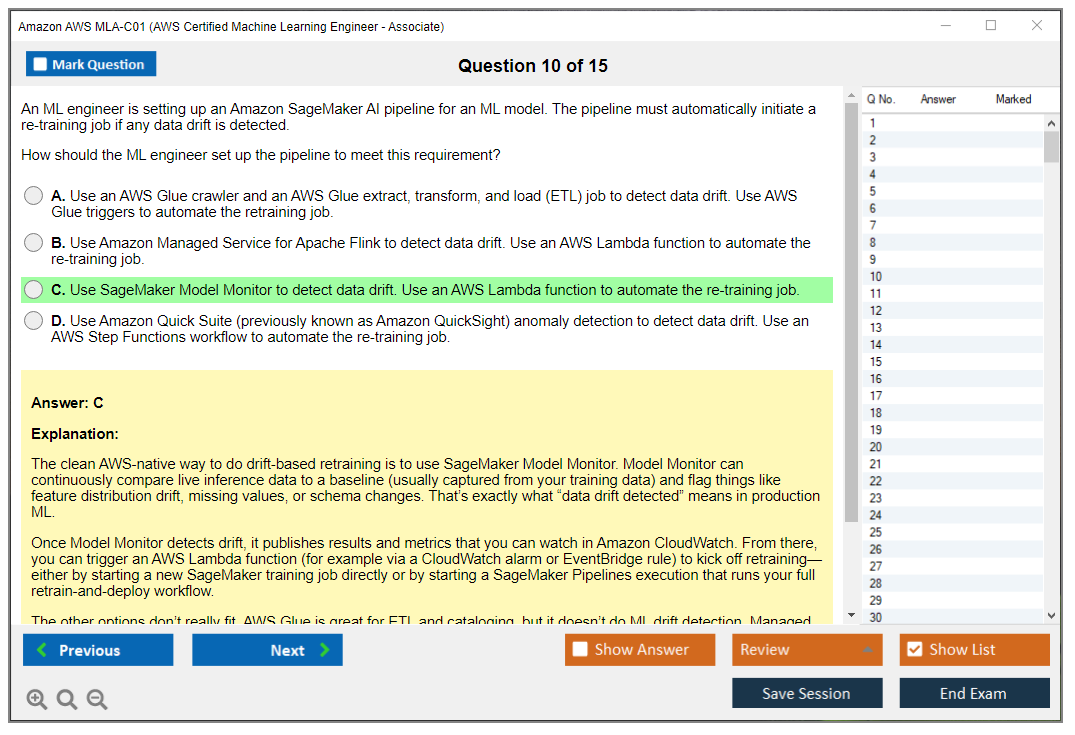
Model monitoring separates hobby projects from production systems. Detecting data drift when input distributions change, model drift when prediction accuracy degrades, setting up automated retraining pipelines triggered by performance metrics, A/B testing frameworks for safely rolling out new model versions.
Troubleshooting skills matter more than most people realize. Training jobs fail for dozens of reasons from data format issues to resource constraints. Inference latency spikes need quick diagnosis. Model quality suddenly drops and you need to figure out why. Sometimes it's just data quality issues upstream that nobody caught. The exam includes scenarios testing your debugging methodology.
Career implications and value proposition
Organizations desperately need people with these skills right now. Not gonna lie, the salary bump can be significant when you prove you can actually operationalize ML systems. Companies waste millions on ML initiatives that never reach production. Engineers who can prevent that waste? Valuable.
The cert provides industry recognition from a leading cloud provider. It's accepted globally as proof you know AWS ML engineering. More importantly, preparing for it forces you to get hands-on with services you might not touch in your day job. That breadth of knowledge makes you more effective even if you never take the exam.
Real-world application and decision-making
Should you use SageMaker's built-in algorithms or bring your own? The exam tests judgment calls you face daily. When does serverless inference make sense versus always-on endpoints? How do you handle different deployment patterns for different use cases in the same organization?
These aren't textbook questions with obvious answers. You need to consider constraints like budget, latency requirements, team expertise, regulatory compliance, scalability needs. The scenarios reflect what you'd actually encounter implementing ML systems in enterprises. Companies running SOA-C02 or SCS-C02 workloads have specific operational and security requirements that affect ML architecture decisions.
The certification proves you can make these calls confidently with real business impact riding on your choices.
MLA-C01 Exam Details
What this certification actually is
The AWS MLA-C01 certification is Amazon's associate-level badge for people building ML systems on AWS and keeping them running. Not research stuff. It's about ML engineering on AWS, meaning data flows, training jobs, deployments, monitoring, and the whole "why's this endpoint suddenly slow and expensive" mess.
The name says "engineer" for a reason. You're expected to recognize the right AWS service for the job, wire it up correctly, and make tradeoffs when the business constraints get ugly. I mean, when you're balancing cost, latency, security, and operational overhead all at once, things rarely line up perfectly. Sometimes you just have to pick the least-bad option and document why.
Who should take the MLA-C01 exam?
If you're aiming for AWS Certified Machine Learning Engineer Associate and you already live somewhere between data engineering and DevOps, this exam fits. Folks shipping models, owning pipelines, babysitting endpoints, or doing MLOps on AWS all day will feel at home here.
A pure data scientist can pass it, sure. They usually struggle when questions turn into IAM, VPC networking, cost controls, deployment patterns, and operational debugging. That's where the exam actually lives.
Format, duration, and question types
The exam is 85 questions. Total. You'll see classic multiple-choice (pick one) and multiple-response (pick more than one). Scenario heavy. Very "here's a business problem, what do you do on AWS?"
You get 170 minutes, which is 2 hours and 50 minutes. That sounds generous, and it kind of is, but the math's still tight because the long scenario questions can eat time fast. Especially when you're parsing constraints like "must stay in private subnets," "data can't leave region," "lowest operational overhead," and "latency under 50ms."
No hands-on lab portion exists in the actual test. That said, the exam assumes you've clicked around the AWS console and you've run real commands in the CLI. Questions casually reference things like SageMaker training job logs, endpoint configs, IAM policies, CloudWatch alarms, and deployment behaviors as if you've seen them before. Which, the thing is, you really should have.
A lot of questions are written like a mini ticket from a product team. You'll get requirements, constraints, and an objective, then you recommend the best architecture, the best AWS service choice, or the right troubleshooting path. The distractors are often technically possible, which is what makes it annoying in a good way. You're not picking "a working answer," you're picking the best answer.
Some items will include JSON policy documents, code snippets, or architecture diagrams. Fragments. A tiny IAM policy with one wrong action. A snippet that hints at a missing KMS permission. A diagram where the data path crosses a boundary it shouldn't. You need to read carefully. I once missed a question because I skimmed right past "must not" in a requirement, and yeah, that was entirely on me.
Where and how you take it
The AWS machine learning associate exam is delivered through Pearson VUE. You can take it at a testing center or online proctored from home or the office.
Online proctoring is convenient, but it's picky. You need a quiet private room, stable internet, a government-issued ID, and you'll do a system compatibility check ahead of time. Webcam on. Desk cleared. No extra monitors. Not gonna lie, people fail the check-in more than they fail the questions.
Testing centers are simpler from a "rules" perspective. You show up, they control the environment, and you just take the exam. The downside is scheduling and travel, and sometimes the nearest center isn't exactly close.
MLA-C01 exam cost
The MLA-C01 exam cost is $150 USD in the United States. Regional pricing varies because local currency and market pricing rules apply, so don't assume the exact number if you're outside the US.
Payment's typically credit card, and some regions offer other payment methods through Pearson VUE. You'll need an AWS Training and Certification account to register, manage scheduling, track status, and grab your digital badge if you pass.
Languages available
MLA-C01's offered in English, Japanese, Korean, and Simplified Chinese. AWS sometimes expands languages later, but you should plan on those being the safe options right now.
MLA-C01 passing score and scoring reality
The MLA-C01 passing score is 720 out of 1000. Scaled score. This is where people get confused.
Scaled scoring is AWS's way of smoothing out slight difficulty differences across exam versions. Your raw score, basically how many you got correct, is converted to the scaled score. So no, 720 doesn't mean "72% correct." AWS also doesn't publish the exact percentage needed. Most estimates floating around land roughly in the 70 to 75% range, but it's not official and it can vary by form.
Multiple-response questions are all-or-nothing. Zero partial credit. If the correct answers are A and C, and you pick A, C, and D, you get zero for that question. That detail alone changes how you should approach "select two" style items. Guessing extra options is a great way to torch points.
You get a preliminary pass/fail right after finishing. Your detailed score report typically shows up within 5 business days and breaks down performance by domain. It won't show the questions you missed or the correct answers. If you fail, the domain breakdown's still useful because it tells you where to focus for round two.
MLA-C01 difficulty and what makes it hard
The MLA-C01 difficulty is intermediate. It's associate-level, but it's specialized. You need AWS fundamentals and practical ML engineering experience, not deep math.
The hard part's the breadth plus depth combo. The exam touches lots of services, then goes deep on a few. Especially anything that smells like Amazon SageMaker certification territory. Training jobs, processing jobs, feature workflows, deployment patterns, monitoring, pipelines, and security show up a lot. Plus you'll see data services around it, and you need to understand how to build, train, and deploy ML models on AWS in a way that won't get your account bill posted in Slack for the wrong reasons.
Time management's also real. 170 minutes for 85 questions is about 2 minutes per question, and many scenarios take longer than that if you're not already fluent with the services. Compared to AWS Certified Machine Learning Specialty, it's more accessible and less theory-heavy, but it still expects you to think like an owner of production ML systems.
Exam objectives and domains (what they're really testing)
People ask about MLA-C01 exam objectives, and the short version is: you're being tested on end-to-end delivery and operations, not model theory.
You should be comfortable mapping requirements to services. SageMaker for training and hosting. Data prep with AWS data tools. Security with IAM and KMS. Observability with CloudWatch. Deployment and repeatability with pipelines and CI/CD patterns. And you need judgment when two answers both "work," but one's cheaper, safer, or lower operational load.
Prerequisites and recommended experience
For MLA-C01 prerequisites, AWS doesn't require a formal prerequisite cert. Practically though, you want real familiarity with AWS basics, plus hands-on ML workflows. Data prep. Training. Evaluation metrics like precision, recall, and AUC. Concepts like overfitting and regularization. Nothing too theoretical, but you can't be blank on the vocabulary.
If you've never built a SageMaker endpoint or configured an IAM role for a training job, you're going to feel the gap fast.
Study materials and practice tests
For MLA-C01 study materials, start with the official exam guide and AWS training for the associate ML engineer track. Then live in documentation for SageMaker core workflows and deployment behaviors. Add security docs where SageMaker touches IAM, VPC, and KMS, because those questions are sneaky.
Hands-on matters. Do a small project with a pipeline, deploy a model, add monitoring, break it, fix it. That's the closest thing you'll get to "labs," because the exam won't give you an actual console.
The official practice exam is $40 USD and contains 20 questions. It's not enough on its own, but it's a good calibration tool for wording and difficulty. For MLA-C01 practice tests from third parties, quality varies wildly. Avoid anything that feels like trivia dumps. You want scenario-style explanations, and you want to understand why wrong options are wrong.
Retake policy, results, and renewal requirements
If you fail, you can reschedule immediately, but there's a 14-day waiting period before you can retake the exam. No limit on attempts. Each attempt costs the full fee again, so don't treat it like a casino.
Your result's valid for 3 years. After that you'll need recertification, which is what people mean by MLA-C01 renewal requirements. AWS changes recert rules over time, but the pattern's consistent: keep the credential active by recertifying before it expires. Usually by passing the current version of the exam or the approved recert path shown in your AWS Training and Certification account.
FAQ style answers people search for
How much does the AWS MLA-C01 exam cost? $150 USD in the US, with regional pricing differences.
What's the passing score for MLA-C01? 720 scaled out of 1000, not a simple percentage.
Is the AWS Machine Learning Engineer, Associate exam hard? Intermediate, heavy on real AWS ML engineering decisions and SageMaker depth.
What are the MLA-C01 exam objectives and domains? End-to-end ML system build and operations on AWS, lots of scenario architecture and troubleshooting.
How do I renew the AWS MLA-C01 certification? Your pass is valid 3 years, then recertify through the options listed in your AWS Training and Certification account.
MLA-C01 Exam Objectives and Domains
Breaking down the weighted structure
The MLA-C01 exam objectives split into four domains. Each domain carries specific weight that determines how many questions you'll see. Domain 1 takes up 28% of the exam, Domain 2 sits at 26%, Domain 3 holds 22%, and Domain 4 rounds out with 24%. This isn't random. AWS designed it to reflect what ML engineers actually do in production environments.
You need to understand these percentages when planning study time. I mean, spending equal hours on each domain would be inefficient. Focus heavy on data preparation since it's nearly 30% of your score, then model development, then security and monitoring. Deployment gets slightly less emphasis but still matters.
Data preparation dominates the foundation
Domain 1 covers everything before model training starts. Data collection from S3 buckets, RDS databases, DynamoDB tables, Kinesis streams. You name it. The exam expects you to know when to use which source and how to configure ingestion pipelines that don't break when data formats change or volumes spike.
AWS Glue becomes your primary ETL tool here. You'll work with Glue crawlers for schema discovery, Glue jobs for transformation logic, and the Glue Data Catalog for metadata management. Not gonna lie, the exam loves asking about Glue integration with SageMaker because that's the actual workflow most teams use in production.
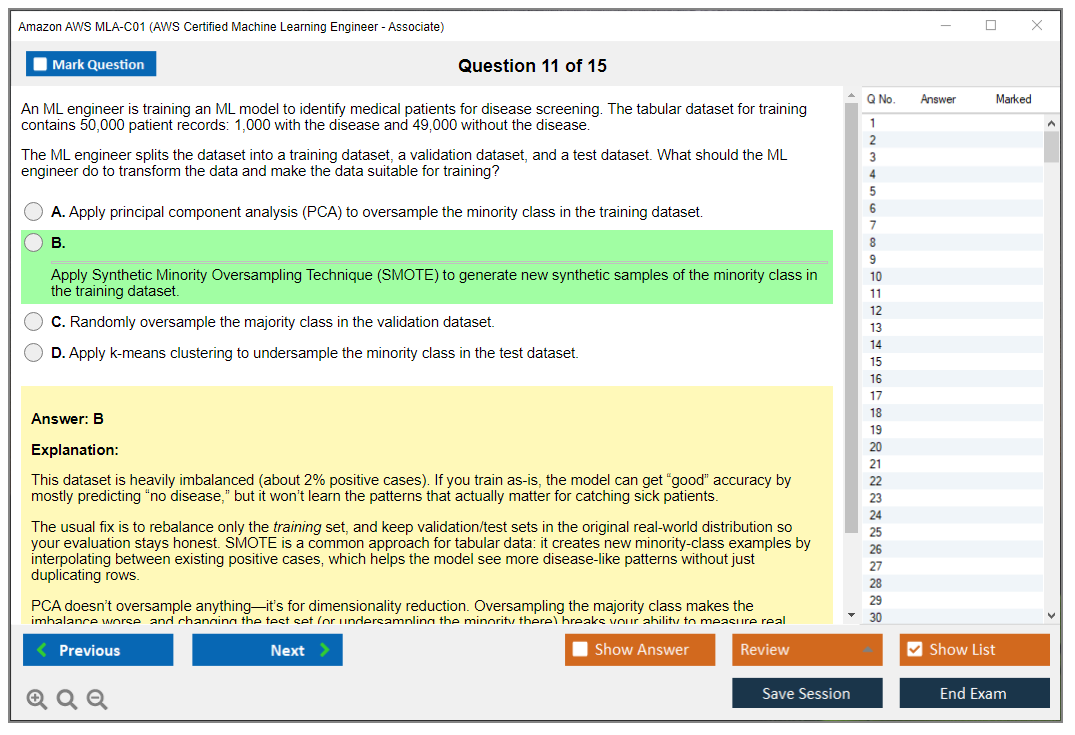
Feature engineering questions hit hard. Normalization versus standardization. When to use one-hot encoding versus target encoding for categorical variables. How to handle class imbalance through oversampling, undersampling, or SMOTE techniques. The thing is, these aren't theoretical. They test whether you know which approach breaks your model and which actually improves performance.
Data Wrangler shows up frequently because it's AWS's answer to interactive data prep. You'll need to know how it integrates with SageMaker Studio, how to export transformations as processing jobs, and when it makes sense versus writing custom Pandas code. The exam also tests data versioning concepts. Tracking which dataset version trained which model matters for reproducibility when things go wrong six months later.
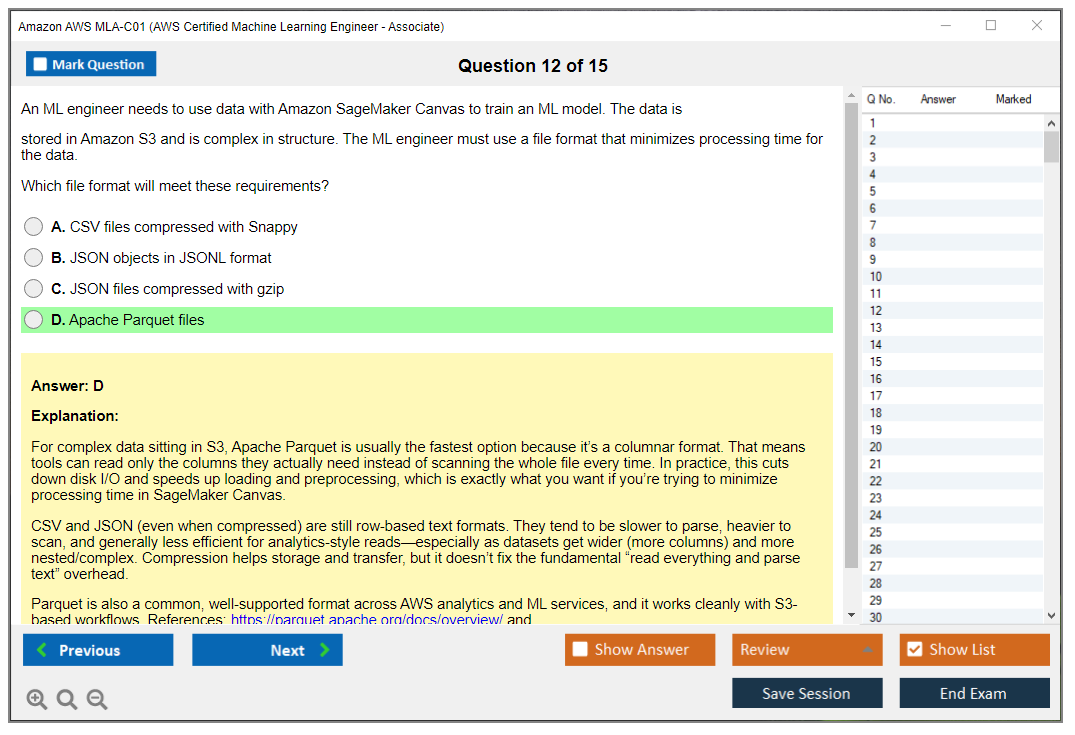
Format selection questions trip people up. CSV works for small tabular data. Parquet optimizes for columnar analytics and saves money on S3 storage. JSON handles nested structures. TFRecord speeds up TensorFlow training. Pick wrong and you'll waste compute dollars or hit performance bottlenecks.
Privacy requirements aren't optional anymore. The exam covers PII detection using services like Macie, data anonymization techniques, and compliance frameworks like GDPR or HIPAA. You need to understand how to implement these controls in automated pipelines, not just conceptually but with specific AWS services and configurations. Kind of reminds me of working with healthcare clients who'd panic over a single unencrypted field in their data lake. That stuff keeps you up at night.
Model development bridges theory and practice
Domain 2 tests whether you actually know how to train models on AWS infrastructure. Algorithm selection questions present business problems like churn prediction, fraud detection, product recommendations. Then they expect you to pick appropriate approaches. Logistic regression for binary classification. XGBoost for tabular data with complex interactions. Neural networks when you have massive datasets and need to capture non-linear patterns.
SageMaker training jobs form the core here. Built-in algorithms like Linear Learner or Object Detection. Framework containers for TensorFlow or PyTorch with your custom code. Bring-your-own-container scenarios when you need specialized libraries. Each approach has different configuration requirements, cost implications, and performance characteristics that the exam explores in detail.
Hyperparameter tuning isn't just "try different values." SageMaker Automatic Model Tuning uses Bayesian optimization to intelligently search the parameter space. You need to know how to define hyperparameter ranges, choose objective metrics, set resource budgets. Also interpret tuning job results. Questions often include scenarios where tuning jobs fail or produce unexpected results. Can you troubleshoot why?
Distributed training strategies matter for large models. Data parallelism splits batches across instances. Model parallelism splits the model itself when it won't fit in single-GPU memory. Pipeline parallelism stages different model layers across devices. The exam tests when each strategy applies and how to configure them in SageMaker training jobs with multiple instances.
SageMaker Debugger monitors training in real-time. Look, it's about tracking loss curves. Debugger catches vanishing gradients, exploding tensors, overfitting patterns, resource bottlenecks. You'll face questions about configuring Debugger rules, interpreting reports, and adjusting training based on what it reveals.
Transfer learning accelerates development when you don't have massive labeled datasets. SageMaker JumpStart provides pre-trained models for computer vision, NLP, other domains. The exam expects you to know when transfer learning makes sense, how to fine-tune pre-trained models. Plus whether transferred knowledge actually helps your specific use case.
Spot instances can slash training costs by 70-90% but introduce complexity. Training jobs might get interrupted. You need checkpointing to resume from interruptions. Honestly, the exam tests whether you understand managed spot training in SageMaker, when spot makes sense versus on-demand instances, and how to architect training jobs that handle interruptions gracefully.
Deployment patterns reflect real-world constraints
Domain 3 covers getting models into production, which is where most ML projects struggle. I've seen this firsthand. Real-time endpoints serve predictions with millisecond latency requirements. You configure instance types, auto-scaling policies based on invocation metrics, multi-AZ deployments for high availability. Questions probe cost optimization. Right-sizing instances. Using inference-optimized instances like Inferentia chips, implementing request batching to maximize throughput.
Batch transform handles large-scale inference without persistent endpoints. Perfect for processing millions of records overnight or scoring entire customer databases periodically. The exam tests when batch makes more sense than real-time endpoints, how to configure input/output channels, how to handle errors during batch processing jobs.
Multi-model endpoints let you host dozens or hundreds of models on shared infrastructure. Models load dynamically based on requests. This dramatically cuts costs when you have many models with sporadic traffic. You need to understand cold start latency, memory management, and when this pattern breaks down. Like when individual models are too large or traffic is too consistent.
A/B testing and canary deployments use production variants. You split traffic between model versions. Maybe 95% to the stable model, 5% to the new candidate. CloudWatch metrics track performance differences. The exam asks how to configure traffic splitting, evaluate variant performance, safely roll back when new models underperform.
SageMaker Pipelines automate the entire ML workflow from data prep through deployment. You define pipeline steps, dependencies, conditional logic. Questions cover parameterizing pipelines, handling failures, integrating with CI/CD tools, implementing approval gates before production deployment. If you've worked with AWS DevOps practices, pipeline concepts feel familiar but ML-specific details matter.
Model Registry provides governance for production models. You register models with metadata, approval status, lineage tracking. Questions test approval workflows, version management, integration with deployment pipelines. This connects to broader AWS architecture patterns around resource management and access control.
Monitoring and security close the loop
Domain 4 addresses production operations that keep ML systems running reliably. Model Monitor detects drift in input data distributions, prediction quality degradation, model bias. You configure monitoring schedules, baseline datasets, CloudWatch alarms triggered by drift metrics. The exam loves scenarios where models degrade silently over months. Can you architect monitoring that catches this before business impact?
Security questions span IAM policies for least-privilege access, encryption configurations, VPC setups isolating ML workloads, network controls. You need to know how to grant SageMaker execution roles access to S3 buckets without opening security holes. How to enable encryption at rest and in transit. How to audit ML operations using CloudTrail logs. This overlaps with AWS security best practices but focuses on ML-specific scenarios.
Cost optimization strategies include right-sizing instances based on actual utilization. Implementing auto-scaling to handle variable traffic. Using Spot instances where appropriate. Cleaning up unused resources like old endpoints or model artifacts in S3. The exam presents scenarios with specific cost constraints and asks how to architect solutions meeting both performance and budget requirements.
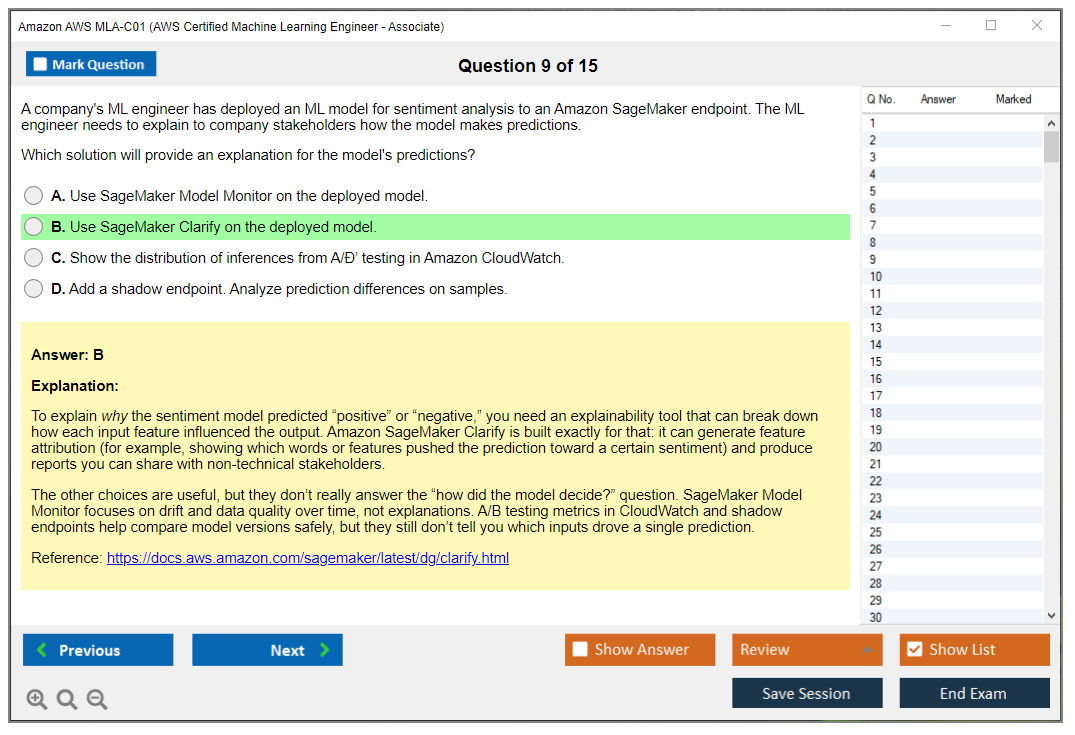
Model explainability using SageMaker Clarify addresses why models make specific predictions. Feature importance scores, SHAP values, partial dependence plots. These help stakeholders trust model decisions. Questions cover when explainability matters most, how to configure Clarify for different model types, how to interpret explanation results for non-technical audiences.
Connecting domains to AWS services
The exam maps objectives directly to AWS services you'll use daily. SageMaker dominates across all domains. Studio for development, Training for model building, Processing for data prep, Pipelines for orchestration, Model Registry for governance, Endpoints for deployment, Model Monitor for production monitoring. Honestly, if you don't know SageMaker inside and out, you'll struggle with this exam.
Supporting services fill critical gaps. S3 stores datasets and model artifacts. Glue handles ETL and data cataloging. Lambda enables serverless inference for sporadic workloads. Step Functions orchestrates complex workflows beyond what Pipelines handles. CloudWatch monitors everything. IAM controls access. VPC isolates resources. ECR stores container images. ECS and EKS run containerized inference workloads at scale.
Service limitations matter in real scenarios. SageMaker endpoints have payload size limits. Training jobs have maximum runtime limits. Batch transform has concurrency limits. The exam tests whether you know these constraints and how to architect around them. Splitting large payloads. Implementing checkpointing for long training jobs. Parallelizing batch jobs across multiple transform jobs.
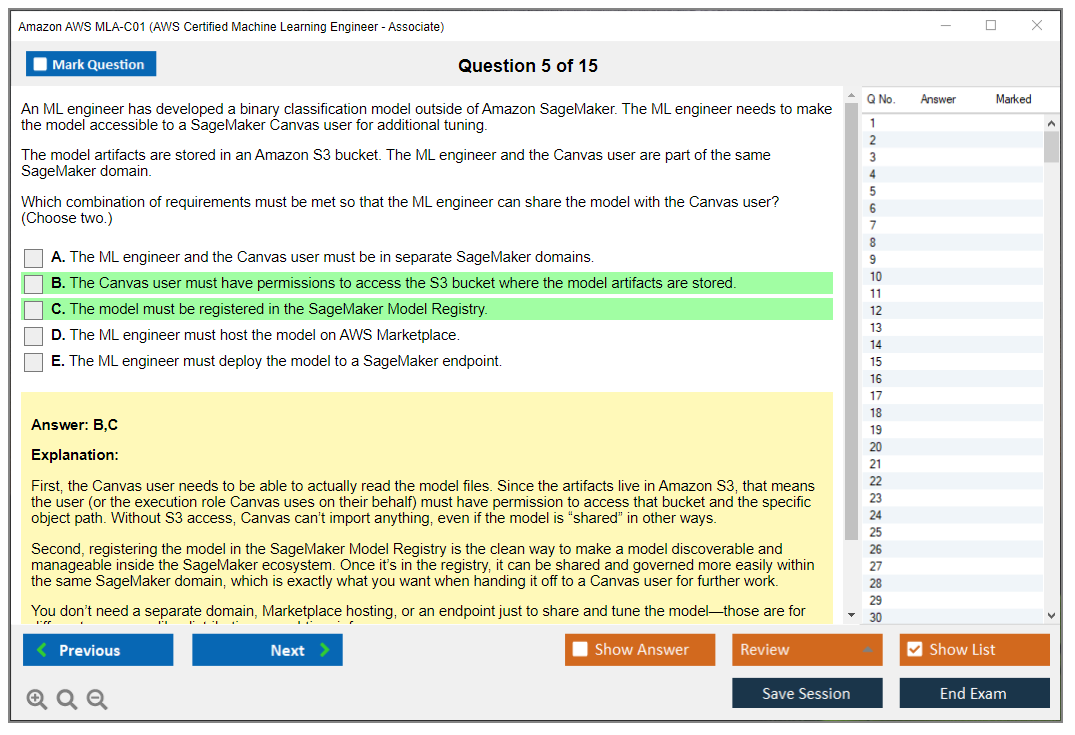
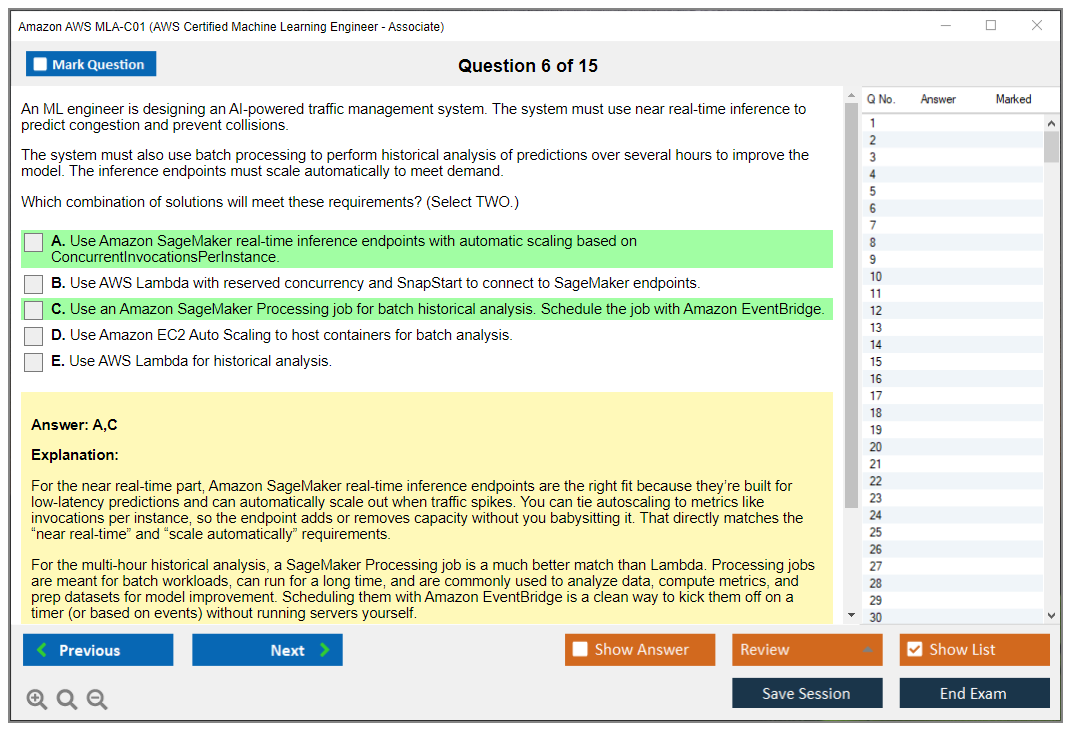
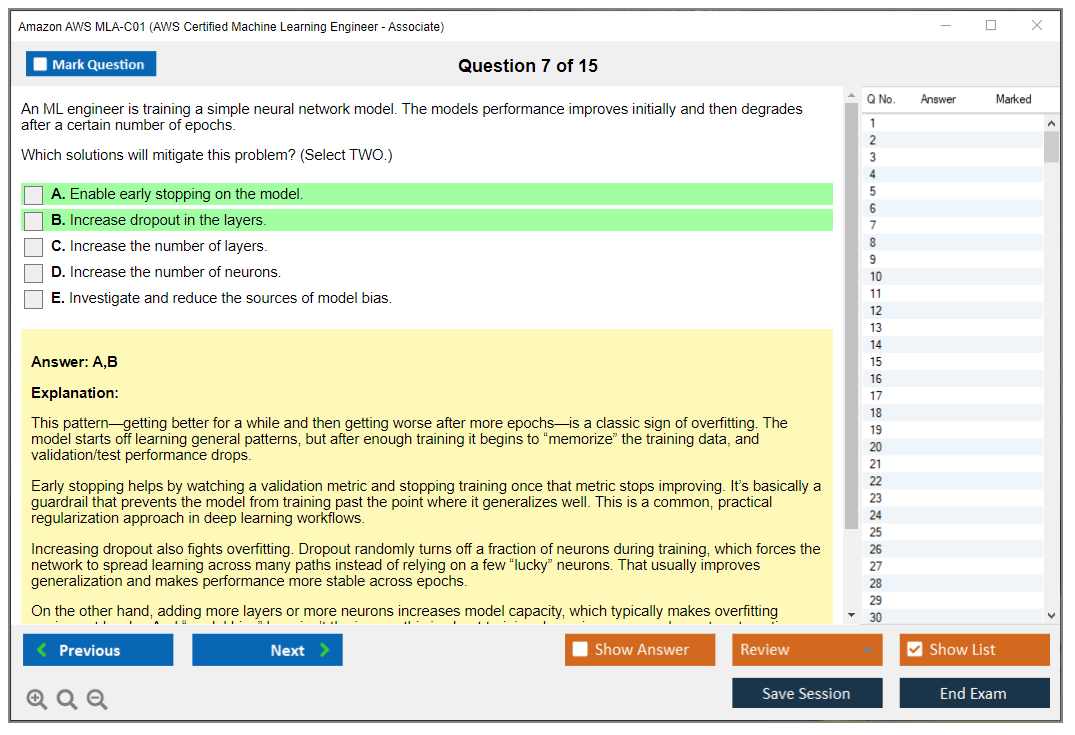
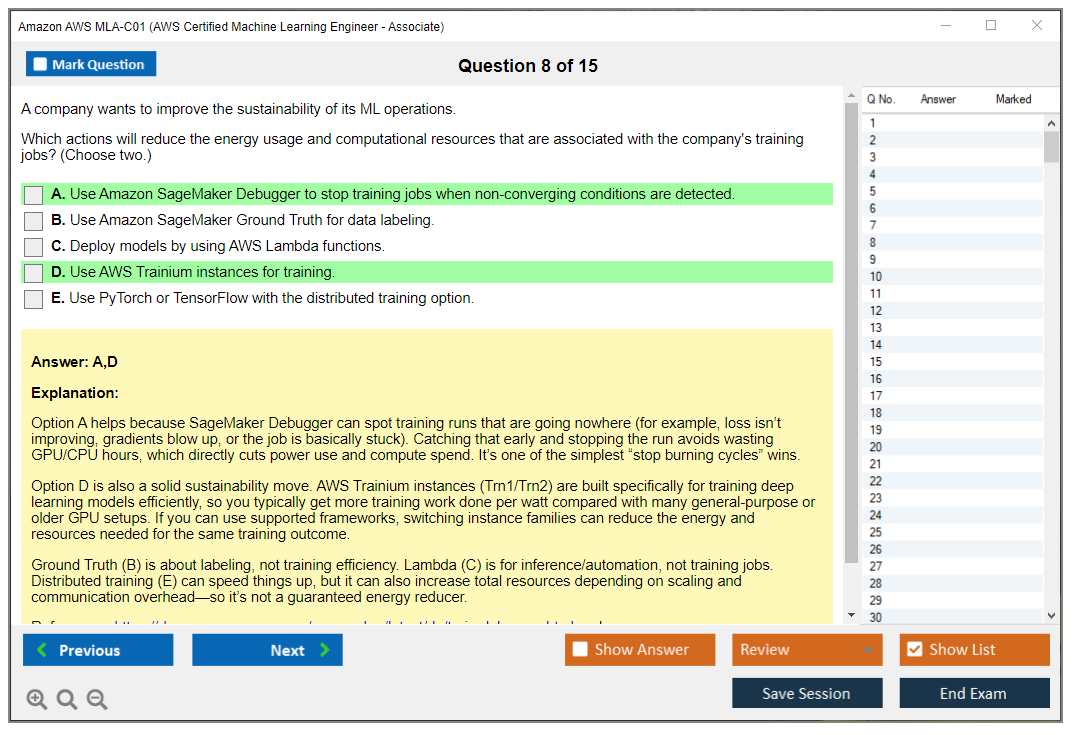
If you're serious about passing, the MLA-C01 Practice Exam Questions Pack helps tremendously. Real exam questions follow specific patterns around service integration, troubleshooting scenarios, optimization trade-offs. Practice tests reveal knowledge gaps before the actual exam where they cost you.
Look, the exam objectives aren't just a checklist to memorize. They represent actual skills ML engineers need building production systems on AWS. Data prep that handles messy real-world data. Model training that scales efficiently. Deployments that serve predictions reliably. Monitoring that catches problems before customers notice. Security that protects sensitive data. Understanding these objectives deeply, not superficially, separates candidates who pass from those who don't. The weighted percentages guide study priorities, but ultimately you need hands-on experience with these services solving real ML problems. Theory only takes you so far. Practice with SageMaker, break things, fix them, optimize costs, and you'll internalize these objectives in ways that stick for the exam and beyond.
Prerequisites and Recommended Experience for MLA-C01
What this cert actually is
The AWS MLA-C01 certification is Amazon's associate-level credential for people who can build, train, and deploy ML models on AWS without falling apart when things hit production. Look, it's closer to "ML engineering on AWS" than academic machine learning, and honestly that's why a lot of folks like it. You're expected to know how SageMaker fits with S3, IAM, VPC, CloudWatch, and a bunch of data services. Not just how to pick an algorithm, but how everything actually connects when you're trying to ship something real.
Who should even bother taking it
If you're already doing ML-adjacent work and want a clean way to prove you can operate in AWS, the AWS Certified Machine Learning Engineer Associate is a solid bet. Data engineers who keep getting pulled into modeling tasks? Yeah. App engineers shipping "smart" features? Absolutely. Cloud folks moving toward MLOps on AWS? Makes sense.
Not for everyone though. New-to-AWS beginners struggle. Pure theory people too.
Also folks who hate debugging permissions. I mean, if IAM errors make you want to flip your desk, maybe reconsider. The thing is, if you're planning to prep with a question pack like the MLA-C01 Practice Exam Questions Pack, you'll get way more value if you've already clicked around the console and broken a few things yourself. Context matters more than memorization here.
Exam format and what questions feel like
The AWS machine learning associate exam is mostly scenario questions. You'll get "here's the goal, here's the constraint, what's the best approach" style prompts, and they love mixing services in ways that feel suspiciously like your actual job. Not gonna lie, it's rarely "what does this service do" and more "which combo of services, configs, and security choices makes sense right now given cost, latency, and compliance requirements."
The MLA-C01 exam cost is set by AWS like their other associate exams. Check the AWS cert site for the current price in your region and any taxes. Budget for a retake too, because plenty of smart people fail the first attempt when they treat it like a memorization contest instead of an architecture reasoning test.
MLA-C01 passing score
AWS doesn't publish a simple "X out of Y" deal. The MLA-C01 passing score is based on scaled scoring, so two versions of the exam can feel different but still be scored fairly. Translation: don't obsess over the number. Obsess over whether you can reason through the architecture and operational tradeoffs in the MLA-C01 exam objectives. Can you defend your choices? That's what matters.
What makes it feel hard
The difficulty comes from breadth, honestly. You're juggling ML concepts, data handling, deployment patterns, and AWS security and networking, and the test will happily throw IAM roles, VPC endpoints, and endpoint autoscaling into the same question like it's no big deal. Look, if you've only trained notebooks locally, this exam will feel rude. It assumes you've dealt with production headaches.
Domains and what AWS expects you to know
The MLA-C01 exam objectives map to the real lifecycle: data prep, training, evaluation, deployment, and operations. You'll see a lot of Amazon SageMaker certification-adjacent content, but the exam absolutely tests the glue around it. Like S3 organization, Kinesis for streaming, EventBridge for automation, and CloudWatch for monitoring. It's the connective tissue that trips people up.
Official prerequisites vs what you actually need
Here's the official line on MLA-C01 prerequisites: AWS recommends 1 to 2 years of hands-on experience developing and running ML workloads on AWS. That's the closest thing to a prerequisite you'll get. There are no mandatory prerequisite certifications required, and you don't need to hold anything else before attempting the AWS MLA-C01 certification, which is nice because some vendors make you climb a whole ladder first.
Foundational AWS knowledge still matters though. A lot. The AWS Certified Cloud Practitioner is a helpful foundation in core AWS concepts, services, and cloud fundamentals, especially if terms like security groups, IAM policies, and S3 bucket policies blur together for you. I mean, you can skip it, but you shouldn't skip the knowledge itself. That's where people get stuck.
Practical beats theoretical. Every single time. No contest whatsoever.
If you want my baseline recommendation, it's 6 to 12 months actively working with AWS ML services in either development or production. The exam questions assume you've dealt with annoying real-world stuff like permissions that mysteriously break, dataset drift that nobody noticed for three weeks, versioning models without losing your mind, and why your endpoint suddenly got expensive overnight. Study materials help, sure, but practical experience can't be substituted entirely by videos and flashcards. The test is full of "what would you do next" situations that only click if you've actually built, trained, and deploy ML models on AWS end to end. Wait, I meant deployed, but you know what, sometimes you're juggling five things and syntax gets weird.
I once spent an entire Tuesday tracking down why a model worked perfectly in my notebook but threw cryptic errors in SageMaker. Turned out I'd specified the wrong IAM role and the training job couldn't read from S3. The error message was.. let's call it "unhelpful." That's the kind of thing no tutorial really prepares you for, but once you've lived it, you spot it instantly on exam questions.
ML knowledge you need (without becoming a math wizard)
You need fundamental ML concepts, but you don't need advanced mathematics or deep learning theory expertise. Expect to be comfortable with supervised learning like classification and regression, unsupervised learning like clustering, and basic evaluation metrics that actually mean something in context.
Know what accuracy hides. Know when AUC helps. Know what RMSE means.
Also understand overfitting and underfiring.. ugh, underfitting (see, brain typos happen). The bias-variance tradeoff, and regularization at a practical level. If you can explain why a model performs great on training data and badly on new data, and what you'd try next without just saying "add more data," you're in the right zone.
Programming and tooling expectations
Python is basically the default language here. Basic programming skills in Python are strongly recommended because AWS ML examples, SDKs, and SageMaker workflows are Python-heavy, and trying to translate everything to another language is just extra pain. You should be comfortable manipulating data with pandas and NumPy, and you should recognize or have used scikit-learn, TensorFlow, or PyTorch in some capacity.
You don't need to be a framework celebrity. You do need to read code. And edit it safely.
Command-line comfort matters too. You should be okay with AWS CLI, and at least the concept of infrastructure-as-code, because real ML systems are infrastructure plus code plus data. The exam loves asking how you'd make things repeatable and secure. Clicking buttons in the console is fine for learning, but you can't scale that, and AWS knows it.
AWS knowledge beyond "the ML services"
This is where people get surprised, honestly. The recommended AWS knowledge spans multiple service categories beyond SageMaker, and that breadth is what separates people who pass from people who memorized SageMaker feature names.
Compute is a big one: EC2 instance types and when GPU instances make sense versus when they're overkill, Lambda functions for lightweight tasks, container services like ECS or EKS when you're packaging inference, and the basic use cases for each. Storage is everywhere: S3 bucket management, lifecycle policies, storage classes, and data transfer patterns. If you can't reason about S3 prefixes, encryption, and moving data efficiently, you'll miss easy points that have nothing to do with modeling.
Databases show up too. Know when RDS is the right fit for structured data, and when DynamoDB makes sense for NoSQL access patterns tied to ML workloads like feature lookups or low-latency app reads. Then there's networking: VPC configuration, security groups, subnets, private/public access patterns, and how to keep training and inference from accidentally living on the public internet where someone's definitely gonna probe it.
IAM is non-negotiable. Roles, policies, permissions boundaries, and the principle of least privilege, which sounds simple until you're three layers deep in a role assumption chain. The exam keeps coming back to "how do we lock this down without breaking it," and honestly that's the job. Security incidents in production ML systems are spectacularly bad.
Data preparation experience that actually counts
Data prep is most of the work in real ML, and the test reflects that reality. You should have experience cleaning, transforming, doing feature engineering, and handling large datasets that don't fit in memory on your laptop.
Missing values happen constantly. Duplicates happen more than you'd think. Outliers happen and ruin everything.
You'll want familiarity with different data sources too: batch data in S3, streaming data from Kinesis, database queries, and API integrations. Data quality assessment matters, like implementing validation rules and catching weird shifts early before they poison your training. Feature engineering basics show up a lot: scaling and normalization, encoding categorical values, binning, and derived features, plus understanding data splitting strategies and preventing data leakage between train, validation, and test sets. That's embarrassingly easy to screw up if you're not careful.
Training and evaluation on AWS infrastructure
You should be able to select appropriate algorithms based on problem type, data characteristics, and business constraints, and then translate that into an AWS training setup that actually runs without burning your budget. That means configuring training jobs with sensible hyperparameters, choosing instance types, and allocating resources without lighting money on fire because you accidentally left a p3.16xlarge running all weekend.
Hyperparameter tuning comes up. A lot. You should understand what an experiment is doing, how to interpret results, and when the "best" metric score is probably lying to you because the validation setup was flawed or someone accidentally used the test set early.
Metrics also matter in context: accuracy, precision, recall, F1, AUC-ROC for classification, and RMSE or MAE for regression. Know which metric matches the business risk. The exam likes questions where the "best" answer is the one that matches the constraint, like prioritizing recall when false negatives are expensive, not the one with the fanciest model name.
Deployment, operations, and MLOps expectations
Deployment is where theory-only prep breaks down completely. You should have experience deploying models as REST APIs for real-time inference with scaling configurations, plus batch prediction workflows for large datasets. Then monitoring: CloudWatch metrics, logs, alarms, and EventBridge triggers for automation when something goes sideways.
Latency problems are real. Endpoint errors happen randomly. Costs creep up fast.
You'll also want to understand monitoring model performance in production and detecting degradation over time, and how automated retraining pipelines work when performance drops below acceptable thresholds. This is basically MLOps on AWS: pipelines that orchestrate data prep, training, evaluation, and deployment, version control with Git because otherwise you'll lose track of what's deployed where, CI/CD principles applied to ML, and managing model versions, artifacts, and metadata for governance and auditing. The thing is, this stuff sounds boring until you're debugging why last week's model suddenly disappeared from production.
How to prep without wasting months
Combine study with building something real. One end-to-end project beats ten courses. It forces you to touch IAM, S3 layouts, training jobs, endpoints, and monitoring in one messy package that resembles actual work. Use free tier and AWS credits to keep costs down, and pick projects that match the exam's style, like tabular classification with SageMaker training, batch transform to S3, and a simple endpoint behind IAM auth.
If you want targeted drilling after you've built something, that's where MLA-C01 study materials and MLA-C01 practice tests help, especially a set like the MLA-C01 Practice Exam Questions Pack when you want lots of scenario prompts and service-mixing questions. I'd use it late in prep, not as the first thing you do. Otherwise you're just training your brain to guess patterns instead of understanding architecture decisions.
Quick FAQ points people ask anyway
How much does the AWS MLA-C01 exam cost? It's the standard AWS associate exam price, and you should confirm the latest number on AWS's site for your country since pricing varies and occasionally changes.
What is the passing score for MLA-C01? AWS uses scaled scoring, so focus on mastering domains and not chasing a specific raw score that nobody will tell you anyway.
Is the exam hard? If you lack hands-on AWS and MLOps habits, yes. If you've been shipping ML on AWS for a year, it's fair but still demands focused prep.
What are the exam objectives and domains? They cover the ML lifecycle plus AWS architecture, security, and operations across services like SageMaker, S3, IAM, VPC, CloudWatch, and friends. Basically everything you'd touch in a real deployment.
How do I renew it? MLA-C01 renewal requirements follow AWS's recertification rules for active certs, and those policies change sometimes, so check the current AWS certification page when you're close to expiry. Also, keep your notes and labs. Relearning endpoints and permissions from scratch is painful and you'll thank yourself later.
If you're serious about passing, do the hands-on work first, then sharpen with practice questions like the MLA-C01 Practice Exam Questions Pack. That combo matches how the exam thinks: practical reasoning over pure memorization.
Best Study Materials and Resources for MLA-C01
Where to actually start when you're hunting for solid prep materials
Honestly? MLA-C01 study materials are overwhelming.
You've got official AWS stuff, third-party courses ranging from incredible to absolute trash, books that may or may not reflect this specific exam's content, and then there's the hands-on practice component that'll honestly make or break your entire success story here. I mean, this isn't like the CLF-C02 where you memorize definitions and you're done. You need real AWS ML experience.
Most people waste time. They bounce between resources without any real plan, starting with random YouTube videos, grabbing a Udemy course, then panic-buying practice exams two days before their test date. Not gonna lie, I've watched that pattern fail repeatedly.
AWS's official training materials (the foundation you can't skip)
The Official AWS training and exam guide is your starting point. Period.
Download the exam guide PDF from AWS Training and Certification. It's free and literally shows you what's on the test. The guide breaks down exam domains with specific AWS services, features, and concepts in scope for each area. You'll see exactly which SageMaker components matter, which data prep services appear, what deployment patterns they actually care about.
Sample questions are included. They demonstrate question format, difficulty level, and scenario complexity you'll encounter. These aren't softballs.
AWS offers the "Exam Prep: AWS Certified Machine Learning Engineer, Associate" digital course through their training platform, focused preparation that maps directly to exam objectives. The AWS Skill Builder subscription ($29/month or $449/year for the annual deal) provides access to their entire catalog of ML and AWS courses. Worth it if you're tackling multiple certs or need broader context.
Instructor-led training is available through AWS Training Partners if you prefer structured classroom or virtual learning environments. More expensive? Yeah. More effective for certain learning styles? Also yeah.
The documentation grind (boring but necessary)
Documentation and whitepapers to prioritize are where things get real.
The Amazon SageMaker Developer Guide is your complete reference for all SageMaker features, APIs, and best practices. SageMaker comprises like 60% of this exam. You need to understand SageMaker Pipelines for MLOps automation and workflow orchestration, not just conceptually but how you'd actually implement them in production environments.
SageMaker Model Monitor documentation covers production monitoring, data drift detection, and model quality assessment. This material appears constantly in scenario-based questions where they describe a deployed model that's degrading and ask what you'd do.
The AWS Well-Architected Framework Machine Learning Lens whitepaper is non-negotiable reading. It covers architectural best practices specific to ML workloads, and exam questions frequently test whether you'd make well-architected decisions or just functional ones. The thing is, industry-specific whitepapers like "Machine Learning Best Practices in Financial Services" help you see applied scenarios that mirror exam questions.
AWS service FAQs for SageMaker, Glue, Athena, and other core services answer weird edge-case questions that trip people up. Like "can you use SageMaker Processing with this specific instance type" or "what's the maximum duration for a training job." Stuff that's not intuitive but definitely shows up.
My buddy spent three days trying to figure out why his SageMaker Processing job kept timing out before he discovered the default time limit in the FAQ. Could've saved himself the frustration.
Hands-on practice (the thing everyone underestimates)
You cannot pass without building stuff. Seriously.
Reading about SageMaker Pipelines is completely different from creating one, debugging it when it fails (and it will), and understanding the IAM permissions nightmare that inevitably comes with it.
Set up projects around exam domains. Build a full ML pipeline from data ingestion through deployment. Use SageMaker Autopilot for automatic model training, then compare it to manual hyperparameter tuning. Deploy a model endpoint with auto-scaling and monitoring configured. Break things on purpose to see error messages.
AWS re:Invent, re:Mars, and Summit session recordings on YouTube provide deep dives into ML services and best practices from the people who actually built them. I've found sessions on specific features often clarify documentation that seemed confusing.
If you're coming from a SAA-C03 or DVA-C02 background, you'll have AWS fundamentals down but need to focus hard on ML-specific services. If you're jumping from the older AWS Certified Machine Learning - Specialty exam, you'll find MLA-C01 more focused on engineering and MLOps versus theoretical ML knowledge.
Third-party courses and where they fit
Platforms like A Cloud Guru, Udemy, and Linux Academy have courses specifically for AWS Certified Machine Learning Engineer Associate prep. Quality varies wildly.
Look for courses updated after exam launch that explicitly cover all domains from the official exam guide.
Some third-party providers offer better hands-on labs than AWS's own training, while others just rehash AWS documentation in video format without adding value. Read recent reviews and check if the instructor has actual ML engineering experience, not just AWS certification collection as a hobby.
Books are tricky because this exam is relatively new. Make sure any study guide you buy is specifically for MLA-C01, not the older ML Specialty exam (MLS-C01). The content overlap is significant but not identical. You'll waste time on topics that aren't tested.
Practice exams that actually prepare you
MLA-C01 practice tests are critical, but trash practice exams hurt more than help.
You want questions that match scenario complexity and multi-service integration patterns of the real exam. Questions that just ask "what is SageMaker Ground Truth" are useless. Real exam questions describe a labeling workflow problem and ask you to choose the best implementation approach.
The MLA-C01 Practice Exam Questions Pack for $36.99 gives you realistic questions that mirror actual exam difficulty and format. I'd recommend doing practice tests in phases: diagnostic test early to find weak areas, topic-focused drills after you've studied each domain, then full timed practice exams in the final week.
When you miss practice questions, dig into why each wrong answer is wrong and why the right answer is right. That process builds the decision-making framework you need when facing unfamiliar scenarios on test day.
Building a realistic study timeline
A study plan should run 2-6 weeks depending on experience level.
If you're already doing ML engineering on AWS in your day job, two weeks of focused review might suffice. If you're transitioning from a different cloud or just starting with MLOps on AWS, plan for 4-6 weeks minimum.
Week one: read exam guide, take diagnostic practice test, review all exam objectives to identify knowledge gaps.
Weeks 2-4: go through each domain systematically with heavy documentation reading and hands-on labs for every major service and feature. Build at least three end-to-end ML projects covering different use cases.
Final week: practice exams, review flagged topics, memorize service limits and specific implementation details that commonly appear as gotcha questions.
Don't try memorizing everything. Focus on build, train, and deploy ML models on AWS workflows and specific services supporting each phase. Understand when you'd choose SageMaker built-in algorithms versus custom containers. Know how to optimize training costs with Spot instances. What monitoring metrics matter for production models.
The pieces people forget about
MLA-C01 prerequisites officially just recommend "one to two years of experience developing, architecting, or running ML/deep learning workloads on AWS Cloud" plus basic ML concepts. In practice, you need solid understanding of data preparation, model training and evaluation, and deployment patterns. If you've never used SageMaker before, add extra study time.
The MLA-C01 exam cost is $150 USD (pricing varies by region). You can retake it if you fail, but there's a 14-day waiting period and you pay full price again. Better to prepare properly the first time.
MLA-C01 passing score isn't publicly disclosed. AWS uses a scaled score from 100-1000 with a minimum passing score of 720. The scoring is weighted by domain, so bombing one area can sink you even if you ace others.
For MLA-C01 renewal requirements, the certification is valid for three years. You can recertify by retaking the current version of the exam or by completing continuing education through AWS Training programs and earning enough credits.
If you're planning a broader AWS cert path, consider how MLA-C01 fits with SCS-C02 for ML security aspects or DOP-C02 for the MLOps pipeline overlap. The Amazon SageMaker certification knowledge also applies if you pursue specialty certs later.
Conclusion
Putting it all together
Look, you don't just pass AWS MLA-C01 by accident. The thing is, it's testing actual ML engineering skills: building pipelines, deploying models, setting up monitoring, the whole MLOps lifecycle that companies need yesterday. You need hands-on time with SageMaker and a solid understanding of how data flows through AWS services, not just theory from binge-watching tutorial videos while taking notes that you'll never review again. The AWS Certified Machine Learning Engineer Associate credential proves you can actually do the work, which matters when you're trying to land that ML role or justify a promotion to management who thinks ML is just magic.
Exam cost? $150. That's reasonable compared to other vendor certs. I mean, have you seen what Cisco charges? You need 720 out of 1000 to pass, which sounds forgiving until you realize AWS loves those scenario-based questions where three answers look plausible and one's technically correct but in a way that makes you question everything. Practice tests become critical here because you're not just memorizing facts. You're learning to think through deployment strategies, cost optimization trade-offs, and troubleshooting scenarios the way AWS expects.
Don't skip hands-on labs
Seriously. Can't stress this enough.
Reading about SageMaker pipelines versus actually building one with data preprocessing, training jobs, and model registry integration? Completely different experience. Night and day. The MLA-C01 exam objectives cover four domains, and each one assumes you've gotten your hands dirty with the services, broken stuff at 2 AM, panicked, then fixed it. Set up a free tier account if you haven't already. Work through real scenarios. Break things and fix them because that's where learning happens.
Your study materials matter too, though some are garbage dressed up with fancy marketing. Official AWS guides give you the framework. Whitepapers explain the architecture decisions behind why things work the way they do. But practice exams show you where your gaps actually are versus where you think they are. Most people think they're ready after two weeks of reading, then hit a practice test and realize they're confusing Lambda deployment with SageMaker endpoints. Or can't remember when to use Data Wrangler versus Glue. Or why AWS has seventeen different ways to do the same thing. Speaking of which, ever notice how AWS naming conventions seem designed by committee? Like someone couldn't decide between being descriptive or catchy so they just did both and added random letters.
Certification stays valid three years. Then you'll need to tackle the renewal requirements through recertification or continuing education. AWS keeps updating their ML services so it makes sense they want you current, not operating on 2025 knowledge in 2028.
If you're serious about passing on your first attempt, quality MLA-C01 practice tests are non-negotiable. Full stop. The MLA-C01 Practice Exam Questions Pack gives you that exam-day pressure with scenario-based questions that mirror the real thing. You'll identify weak spots in specific domains, whether that's model deployment, data engineering for ML, or monitoring and operations. Practice under timed conditions. Review explanations for wrong answers, even the ones you guessed correctly. Then go back and lab out whatever you missed. That's how you learn this stuff and walk into the testing center confident you know your MLOps on AWS inside and out.

